
Ocean Sound EOV Implementation Workshop
Oostende, Belgium
22 September 2026 – 24 September 2026
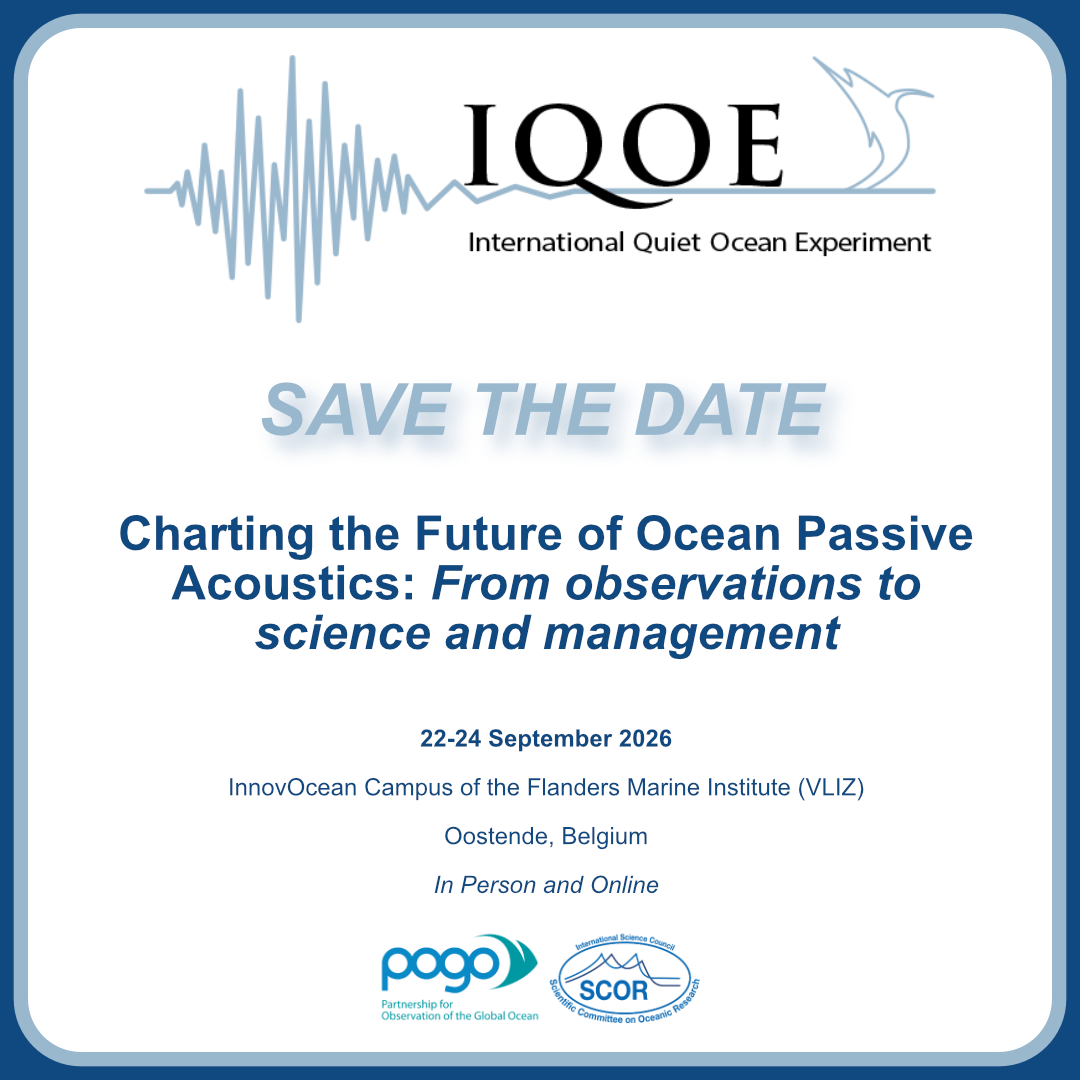
This open workshop will assemble ocean acoustics and bioacousticians to discuss future international activities to observe sound in the ocean through passive methods.
Visit https://www.iqoe.org/workshops/future-ocean-pam for registration and other details
Registration: will open on 1 May 2026
Overview
Background and rationale
Measuring ocean sound systematically worldwide in a standardized way is necessary to determine whether sound is changing in the ocean over time and space, and to understand how any observed changes affect marine organisms. A POGO-supported IQOE group created a specification sheet for an Ocean Sound Essential Ocean Variable (EOV) and IQOE formed a POGO- and SCOR-supported committee to write a plan to implement this EOV. Currently, the Ocean Sound EOV specification sheet is under revision and the Implementation Plan was published in 2023, but IQOE will sunset at the end of 2025. There is no mechanism to continue implementation of the EOV despite considerable support and motivation from the global science community. Implementation of the EOV is important for making ocean sound a regularly measured GOOS variable, and also for understanding whether policy changes related to ocean sound are effective and how short-term perturbations to human activities (e.g., the COVID-19 pandemic) affect sound in the ocean. Implementing the Ocean Sound EOV could contribute to implementing other EOVs, such as for measurements of wind and rainfall over the ocean.
Global Context
IQOE was developed from ideas gathered at an open workshop in 2012, which brought together participants from around the world. The proposed workshop would kick off the new project and provide similar benefits. A plan for a new activity will result from the workshop, focused on implementing the Ocean Sound EOV and providing a home for IQOE-related activities that will continue beyond the sunset of IQOE, including the Global Library of Underwater Biological Sounds (GLUBS), the World Ocean Passive Acoustic Monitoring (WOPAM) Days, the low-cost hydrophone development activity, the Open Portal to Underwater Soundscapes (OPUS), and the global PAM metadatabase. Each of these activities are important for implementing the Ocean Sound EOV.
IQOE is networking the global community of ocean acousticians and bioacousticians, but there is still a need to advance such networking. The EOVs are global and focusing on the Ocean Sound EOV will help bring global attention to the importance of measuring ocean sound. There is no other global coordinating activity for ocean acoustics and bioacoustics, and no other mechanism for implementing the Ocean Sound EOV. The proposed workshop will be important for bringing ocean sound into GOOS.
Representation by developing nations in the IQOE and EOV implementation plans is low. International meetings often suffer from lack of participant diversity and inclusivity, which is necessary for providing a truly global perspective on ocean noise. To address this concern, we are proposing an open meeting to encourage inputs from a diverse set of participants with the meeting held both in person and online (free registration for online participants) and recorded to allow inclusion of those unable to attend in real time due to work, family commitments, or time differences. We will form a subcommittee of early-career scientists (ECSs) to help determine how to best involve both in-person and remote ECS participants (see Urban and Boscolo (2013)).
The meeting will be advertised well in advance to relevant stakeholders through the IQOE, POGO, and SCOR email lists and social media platforms to reach a global audience. Prior to the meeting (and by Nov, 2025 latest), the list of registrants will be reviewed by meeting organizers to identify under-represented areas/regions/participant groups. Through this process, a more targeted strategy of invitations/advertisement will be made to ensure that appropriate representation is invited from these regions/persons to ensure the global participation aim is met. Following the meeting, feedback on diversity and inclusivity will be sought and recommendations integrated into future meetings.
Relevance to POGO and fit with POGO’s Strategy
POGO’s 2021 strategy document states its goal is promote world-wide cooperation for a sustainable and state-of-the-art global ocean observing system that both provides observations to advance ocean science and to meet societal needs. POGO has a reputation of supporting development of key components of GOOS and has played such a role in IQOE, supporting the development of the Ocean Sound EOV, as well as low-cost hydrophone systems. POGO can continue to provide practical support in the area of ocean acoustics and bioacoustics by helping support the development of the next building block for the Ocean Sound EOV.
Work plan, deliverables and milestones (revised Feb 2026)
POGO funding would specifically support travel and lodging and meal expenses for 4 members of the planning committee. The steps in the work plan are the following:
- A planning committee will be formed by 1 September 2025, following approval by POGO and SCOR. The list below is a starting point, whose membership may be augmented by the committee itself, if it finds gap in the expertise proposed. The committee will have no more than 2 members per country and will include several members from POGO institutions.
- The workshop will be announced in March 2026. It will be important to announce the workshop as early as possible because there are several other international acoustics meetings held every year. The SCOR Annual Meeting will be held on 29-31 October 2025, which will determine whether SCOR will contribute funding. If SCOR funding is not provided, the workshop will be cancelled unless other funding can be secured.
- The planning committee will develop a program designed to make it possible for individuals attending the meeting to provide input to develop a written document describing a project to help implement the Ocean Sound EOV. The program will include plenary sessions to provide a foundation of information for participants, followed by breakout sessions so participants can focus on specific aspects of the project design. The workshop will probably last three full days.
- The workshop is planned to be held in September 2026.
- The planning committee will complete the workshop report by the end of April 2027.
| Milestones | Date to be reached | |
| 1 | Form planning committee | 01/09/2025 |
| 2 | Ensure adequate funding committed | 01/11/2025 |
| 3 | Announce workshop | 01/03/2026 |
| 4 | Finalize workshop program | 30/04/2026 |
| 5 | Hold workshop | 22-24/09/2026 |
| 6 | Complete workshop report | 30/04/2027 |
Status: Active Project
Year: 2025-2026
Project website
Members involved



Partners involved
Project Participants
Leader
- Peter Tyack, Woods Hole Oceanographic Institution, USA
Participants
- Lucille Chapuis, La Trobe University, Australia
- Wayne Crawford, Institut de Physique du Globe de Paris (IPGP), France
- Lucia di Iorio, University of Perpignan, France
- Tess Gridley, SeaSearch, South Africa
- Bruce Martin, JASCO Applied Sciences, Canada
- Sophie Nedelec, University of Exeter, UK
- Miles Parsons, Australian Inst. Of Marine Sciences (AIMS), Australia
- Denise Risch, Scottish Association for Marine Science (SAMS), UK
- Karolin Thomisch, Alfred Wegener Institute, Helmholtz Centre for Polar and Marine Research (AWI), Germany
- Carrie Wall Bell, University of Colorado, Boulder, USA